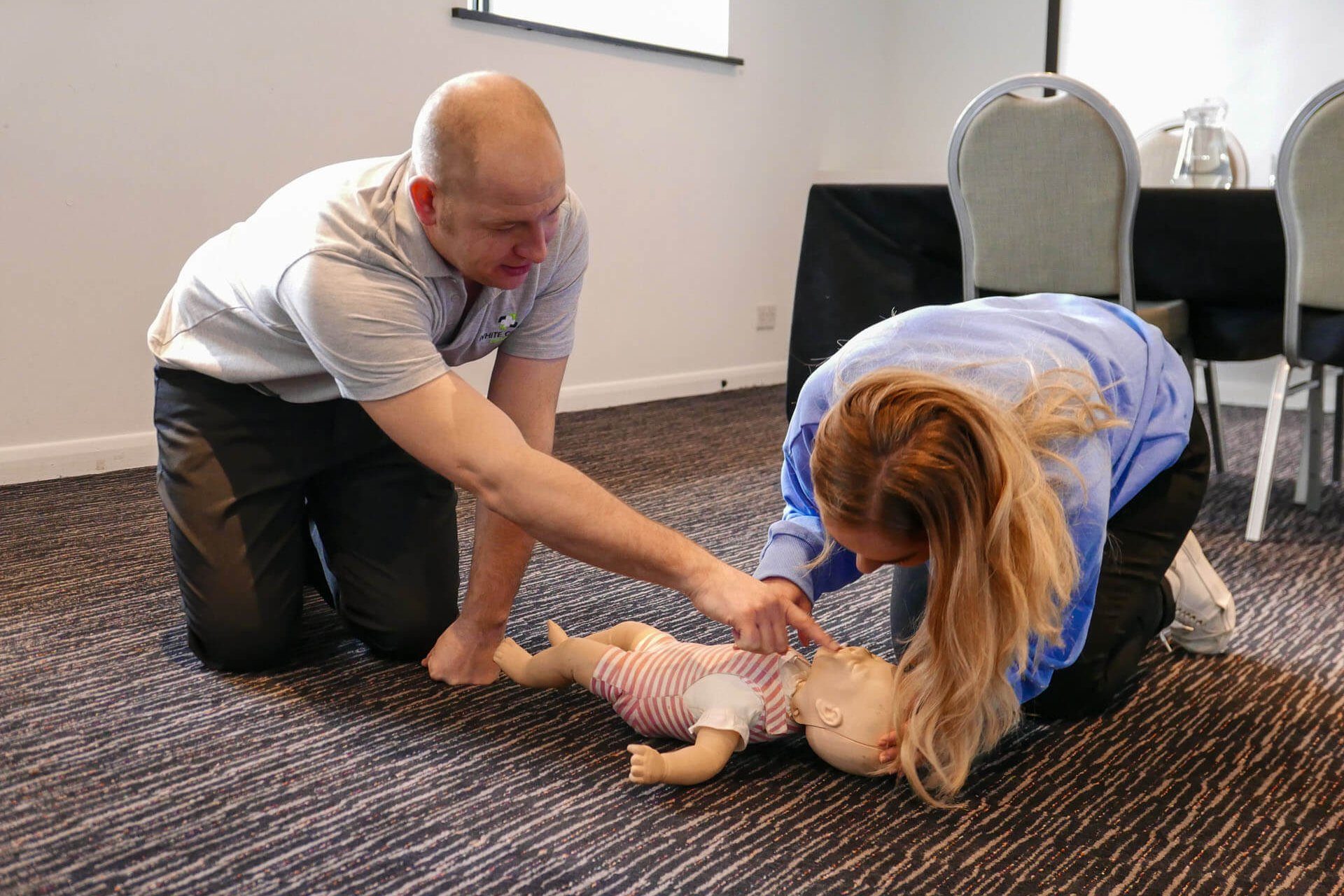
To maintain your First Aid at Work (RQF) certification, a 2-day First Aid at Work Requalification (RQF) course is necessary every 3-years.
Upcoming events for this course
Course Information
First Aid at Work Level 3 (RQF) Requalification
In order to do join a 2-day First Aid at Work (RQF) Requalification course, you must have a copy of your original First Aid at Work (RQF) certificate.
The First Aid at Work Requalification course meets the guidelines and requirements of the First Aid at Work (First Aid) regulations 1981 and subsequent changes made in 2016. It meets the latest Resuscitation Council UK Guidelines as per the HSE requirements.
Spaces on our First Aid at Work Requalification courses are limited to a maximum of 12 people. A hands-on approach ensures that attendees learn first aid skills and have the confidence to use them in a real life situation. Learners are assessed throughout the course on their practical demonstrations, Q&A sessions and quizzes.
We understand that releasing employees from their duties for a full first aid course can sometimes be challenging. We also offer a flexible blended First Aid at Work Requalification course. Attendees complete approximately 6-hours of online training at their own pace, gaining essential knowledge before joining a 1-day practical course with an experienced instructor. This approach ensures that attendees not only build a strong foundation but also get hands-on experience to develop confidence and competence in their first aid skills. Online training modules are available for £25.00 each (£30.00 incl. VAT). The practical session is priced the same as our 1-day Emergency First Aid at Work course.

On successful completion of the course, attendees will receive an accredited First Aid at Work (RQF) certificate which is valid for three years. An annual FAW Refresher Course is highly recommended.
Attendees completing our First Aid at Work (RQF) Requalification courses receive access to a video library for refreshing skills and reference through ProTrainings.
Course Curriculum
Unit 1: Emergency First Aid in the Workplace (credit can be given in some cases if already completed recently)
1 Understand the role and responsibilities of a first aider.
1.1 Identify the role and responsibilities of a first aider.
1.2 Describe how to minimise the risk of infection to self and others.
1.3 Identify the need for establishing consent to provide first aid.
1.4 Complete an accident report form.
1.5 Identify the first aid equipment that should be available in a workplace.
1.6 Describe the safe use of first aid equipment.
2 Be able to assess an incident.
2.1 Conduct a scene survey.
2.2 Conduct a primary survey of a casualty.
2.3 Give examples of when to call for help.
3 Be able to manage an unresponsive casualty who is breathing normally.
3.1 Assess a casualty’s level of consciousness.
3.2 Open a casualty’s airway and check breathing.
3.3 Explain why it is important to place an unconscious casualty into the recovery position.
3.4 Place an unresponsive casualty in the recovery position.
3.5 Manage a casualty who is in a seizure.
4 Be able to manage an unresponsive casualty who is not breathing normally.
4.1 Recognise the need to commence Cardio Pulmonary Resuscitation.
4.2 Demonstrate Cardio Pulmonary Resuscitation using a manikin.
5 Be able to recognise and assist a casualty who is choking.
5.1 Describe how to identify a casualty with a
Partially blocked airway
Completely blocked airway
5.2 Administer first aid to a casualty who is choking.
6 Be able to manage a casualty with external bleeding.
6.1 Identify the types of external bleeding.
6.2 Control external bleeding.
7 Be able to manage a casualty who is in shock.
7.1 Recognise shock.
7.2 Administer first aid to a casualty who is in shock.
8 Be able to manage a casualty with a minor injury.
8.1 Administer first aid to a casualty with small cuts, grazes and bruises.
8.2 Administer first aid to a casualty with minor burns and scalds.
8.3 Administer first aid to a casualty with small splinters
Unit 2: Recognition and Management of Illness and Injury in the Workplace
1 Be able to conduct a secondary survey.
1.1 Identify the information to be collected when gathering a casualty history.
1.2 Conduct a head to toe survey.
2 Be able to administer first aid to a casualty with injuries to bones, muscles and joints.
2.1 Recognise suspected; Fractures, Dislocations, Sprains and strains
2.2 Administer first aid for; Fractures, Dislocations, Sprains and strains
3 Be able to administer First Aid to a casualty with suspected head and spinal injuries.
3.1 Recognise suspected; Concussion, Skull fracture, Cerebral compression, Spinal injury
3.2 Administer first aid for suspected; Concussion, Skull Fracture, Cerebral compression, Spinal injury
4 Be able to administer First Aid to a casualty with suspected chest injuries.
4.1 Recognise the different types of a chest injury.
4.2 Administer first aid for a chest injury.
5 Be able to administer First Aid to a casualty with burns and scalds.
5.1 Recognise the factors that affect the severity of burns and scalds.
5.2 Administer first aid for burns involving; Dry heat, Wet heat, Electricity and Chemicals
6 Be able to administer First Aid to a casualty with an eye injury.
6.1 Give examples of common eye injuries.
6.2 Administer first aid for eye injuries involving; Dust, Chemicals and Embedded objects
7 Be able to administer First Aid to a casualty with sudden poisoning.
7.1 Identify the routes that poisons can take to enter the body.
7.2 Administer immediate first aid to a casualty affected by sudden poisoning.
7.3 Identify sources of information for treating those affected by sudden poisoning.
8 Be able to administer First Aid to a casualty with anaphylaxis.
8.1 Identify common triggers for anaphylaxis.
8.2 Recognise anaphylaxis.
8.3 Administer immediate first aid for a casualty suffering from anaphylaxis.
9 Be able to provide First Aid to a casualty with suspected major illness.
9.1 Recognise major illnesses including; Heart Attack, Stroke, Epilepsy, Asthma and Diabetes
9.2 Administer first aid to a casualty suffering from major illnesses including; Heart Attack, Stroke, Epilepsy, Asthma and Diabetes
Price for this course
- £128.93 each for 2 attendees (£154.71 incl. VAT)
- £122.85 each for 3 attendees (£147.42 incl. VAT)
- £116.78 each for 4 attendees (£140.13 incl. VAT)
- £110.70 each for 5 attendees (£132.84 incl. VAT)
- £104.63 each for 6 attendees (£125.55 incl. VAT)
- £98.55 each for 7 attendees (£118.26 incl. VAT)
- £92.48 each for 8 attendees (£110.97 incl. VAT)
- £86.40 each for 9 attendees (£103.68 incl. VAT)
- £80.33 each for 10 attendees (£96.39 incl. VAT)
- £73.35 each for 11 attendees (£88.02 incl. VAT)
- £67.50 each for 12 attendees (£81.00 incl. VAT)
The prices above are for venue-based courses and private bookings for 4 or more attendees.
We are also pleased to offer private courses for 3 attendees or less. These can be delivered at your place of work or home. Please let us know if this is something you’d like to organise.
Booking enquiry
If you would like to book this course, please complete the form and we’ll be in touch as soon as possible.