
Traditionally, responders have been taught to deflate the mattress or move the patient to the floor. But modern active mattresses, especially dual-layer systems, are changing what’s possible in real emergency situations.
This study, conducted by Laurence Peacock and presented at Wounds UK 2025, examined CPR performance on Vestims® active mattresses from Squirrel Medical. These mattresses are designed with a permanently inflated lower chamber to provide a firm base, while the upper layer alternates for pressure redistribution.
What We Tested
Using a Laerdal QCPR manikin, CPR performance was recorded across three scenarios:
- Floor (control)
- Mattress fully inflated
- Mattress deflated using the CPR valve
Two mattress models were included (15 cm and 18 cm). All trials were performed by the same evaluator to maintain consistency.
Key Findings
Across all scenarios and mattress types, CPR quality remained extremely high:
- 99% CPR success rate whether the mattress was inflated, deflated, or the manikin was positioned on the floor.
- The evaluator strongly preferred performing CPR with the mattress fully inflated, noting:
- Immediate readiness—no searching for CPR valves
- Better patient head positioning
- Easier maintenance of the head-tilt chin-lift
- A stable base under the torso
The permanently inflated lower chamber effectively mimicked the stability of a firm, carpeted floor, removing many traditional concerns about “soft surfaces” compromising compressions.
Why This Matters
The results suggest that modern dual-layer active mattresses can support immediate, uncompromised CPR, without needing to:
- Move the patient to the floor
- Activate a CPR valve
- Delay chest compressions
This could simplify guidance in care environments where responder experience varies. A clear instruction—“start CPR immediately”—reduces hesitation and cognitive load.
The findings also support earlier work (such as Soppi et al., 2016) while offering important new insight into how mattress design affects emergency readiness.
Conclusion
Our independent study found that:
- High-quality CPR can be performed effectively on Vestims® mattresses in both inflated and deflated states.
- The stable lower chamber design removes the need for CPR valve activation.
- This dual-layer approach may contribute to future updates to CPR protocols involving active support surfaces.
These findings offer valuable reassurance for any environment where alternating pressure mattresses are essential for patient care but emergency preparedness must remain uncompromised.
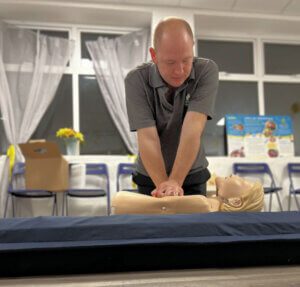
Instructor Laurence Peacock demonstrating chest compressions on a manikin placed on a fully inflated Vestims active mattress as part of the White Cross Training CPR study.