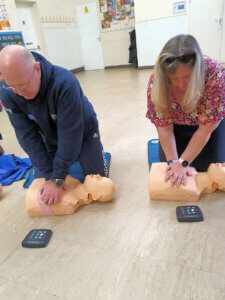
We know how busy schools are. Between SATs, school plays, lost jumpers and the never ending pile of marking, there’s always something demanding attention. But here’s the thing: as parents ourselves, we know there’s one priority that can never slip down the list — keeping children safe, which is why spare adrenaline auto injectors in schools matter so much.
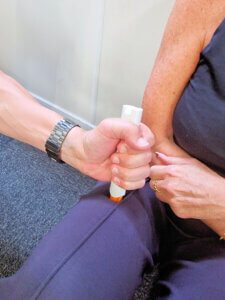
Every day, parents hand over their children at the school gate and trust that staff will know what to do in an emergency. That’s a huge responsibility, and one we take very seriously. With two little girls of our own, we feel that responsibility just as much as you do.
Sam was a teacher before starting White Cross Training, so she knows what schools are like: the pace, the pressures, the constant juggling. We completely understand how another training session might feel like “one more thing” on top of a busy term. But if an allergic reaction happens, it can’t wait until after assembly, or until someone finds the key for the locked cupboard. That’s why having spare adrenaline auto-injectors (AAIs), and staff who are confident to use them, is so important.
Why Spare Adrenaline Auto Injectors in Schools Matter
Since 2017, schools have been able to buy and keep spare AAIs without a prescription. They’re there as a back-up if a child’s own injector is missing, expired or fails.
In the rare but frightening situation where a child has an undiagnosed allergy and suffers a sudden reaction, spare AAIs can still legally be used to save their life. Recent professional guidance (MHRA-aligned advice) highlights the importance of rapid access and staff who are ready to act.
In an emergency, confidence is everything.

A Sobering Reminder
This isn’t just theory. In December 2021, five-year-old Benedict Blythe suffered a fatal allergic reaction at school after being exposed to cow’s milk, despite his severe allergies and existing safety measures. An inquest revealed that his allergy plan wasn’t followed: his oat milk was poured in a staffroom instead of in class, cross-contamination occurred, and administration of his adrenaline auto-injector was delayed. His mother described his death as “a cascade of failures” that should never be allowed to happen again. His family are now campaigning for “Benedict’s Law”, which would make allergy policies, spare injectors and training compulsory in every school. Their message is clear: no family should ever have to go through what they have.
The national conversation continues, and the House of Commons Library briefing highlights just how important robust policies are in protecting children with medical conditions.
The bigger picture: a postcode lottery for allergy safety
At the moment, allergy safety in schools across the UK is patchy at best. Statistics shared in the House of Commons show that around two children in every classroom live with a food allergy, and shockingly, 80% of severe reactions happen in school, including a quarter of first-time anaphylaxis cases. Yet despite this, there’s no consistent national approach.
For example:
- In some schools there’s a spare adrenaline auto injector available, and in others there isn’t.
- Many staff have never received allergy training, or don’t know how to recognise the symptoms of a severe reaction.
- A large number of schools have no allergy policy in place at all, or fail to keep individual healthcare plans for pupils.
It really does come down to a postcode lottery, and that’s why the new Schools (Allergy Safety) Bill is so important. If passed, it would make allergy policies and training mandatory in every school, alongside a requirement to hold spare adrenaline auto injectors — treating them with the same seriousness as defibrillators.
Until there’s a consistent national framework, the risk is that parents, staff and children are left relying on luck. That isn’t good enough. Every child deserves the same level of protection, no matter what school they attend.
What we do
At White Cross Training, we always include anaphylaxis awareness training as part of our first aid courses, whether that’s Emergency First Aid at Work, Paediatric First Aid, or First Aid at Work.
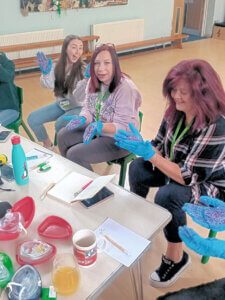
We also run standalone, hands-on anaphylaxis sessions just for schools. They are perfect for INSET days or after-school staff training. It’s not about ticking a box; it’s about putting an injector in people’s hands so that, if the worst ever happens, they’re not hesitating, they’re acting.
For structured support and templates, we signpost to Anaphylaxis UK’s
Safer Schools Programme. Our practical training complements these resources with real-world, hands-on confidence.
Because yes, schools are busy. Yes, the to-do lists are endless. But nothing matters more than knowing every child is safe, and that’s why spare adrenaline auto injectors in schools are so important.
If you’d like to feel confident your staff are ready for anything, we’d love to help.