
It’s the Little Things: What Makes a Great First Aid Training Course?
When people book a first aid course, they usually look at the qualification, the price, the location and how long the training will take.
And understandably so.
But have you ever thought about all the little things that go into delivering a first aid course?
I’m Laurence, one of the first aid instructors at White Cross Training, and I’ve been teaching first aid for many years.
Over that time, I’ve developed my own way of doing things. Nothing particularly groundbreaking, and I’m certainly not claiming to have invented a new way of teaching.
But I do believe the little things matter.
From how I arrange the tables to the questions I ask, there are lots of small decisions throughout the day that I hope make a difference to someone’s learning experience.
It Starts Before Anyone Arrives
One of the first things I think about is how to arrange the room.
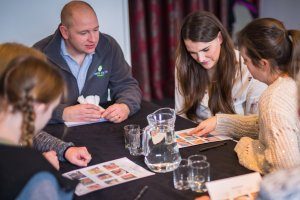
Wherever possible, I like to set the tables out in a horseshoe shape. It means everyone can see one another, there’s space in the middle, and it makes it easier to have conversations as a group.
Of course, not every venue has enough space for this, so sometimes a boardroom-style arrangement works better.
It might seem like a small thing, but I want the room to feel welcoming and encourage people to get involved.
Getting to Know the People in the Room
When learners arrive, I’ll introduce myself and usually ask how far they’ve travelled.
Then I’ll quietly make my way around the room and speak to people individually.
I’ll ask what they do for work and whether they’ve done any first aid training before.
There’s a reason for this.
Someone working in an office might face very different situations from someone working on a building site, in a nursery or in a restaurant.
By finding out a little about each person, I can adapt the examples and discussions throughout the course to make the training more relevant to them.
It also gives me an idea of how much previous experience people have.
Some have been first aiders for years. Others are attending their very first course and might be feeling a little nervous.
I think it’s important to recognise that everyone arrives with different experiences.
Understanding the Person, Not Just the Learner
Over the years, I’ve also taken an interest in body language, personality and human behaviour. I’ve read books on these subjects because I’m interested in understanding how people communicate and respond to different situations.
When I’m teaching, I try to pay attention to more than just the answers people give.
Some learners are naturally confident and happy to speak in front of everyone. Others are quieter, and some might be feeling quite anxious about the course.
I pay attention to how comfortable people seem during the day and adapt my approach where I can.
I don’t believe everybody learns or communicates in exactly the same way.
For me, understanding the people in the room is just as important as understanding the subject I’m teaching.
Please Ask Questions!
When I formally introduce myself at the beginning of the course, I don’t spend ages talking about my qualifications or experience.
I don’t particularly enjoy talking about myself, and I certainly don’t want to come across as boasting.
What I do tell everyone is that I love questions.
If there’s something you’re unsure about, please ask.
I don’t want people sitting quietly for hours wondering about something because they’re worried it might be a silly question.
Questions often lead to some of the most interesting discussions of the day.
And sometimes a question from one learner is exactly what somebody else was thinking but didn’t want to ask.
What Time Do We Finish?
This is probably one of the most common questions I’m asked before we’ve even started.
“What time do we finish?”
My response is often another question.
“Do you know how long an ambulance will take to arrive for someone with a broken leg?”
Of course, the answer depends on the circumstances.
And in some ways, teaching first aid is similar.
Every group is different.
Some groups have lots of previous experience, while others are learning everything for the first time. Some ask question after question, while others need more time to practise particular skills.
There’s always a course plan, an expected timetable and learning outcomes we need to achieve.
But I also want to allow time for questions, discussion and practice rather than rushing people along simply because we’re watching the clock.
Ultimately, I want people to leave knowing what to do if someone needs their help.
I Don’t Want to Be the Only Person Talking
I use PowerPoint during my courses, but I also use practical demonstrations, discussions and activities.
I like a mixture.
I don’t want learners sitting there listening to me talk all day.
As I get to know the group, I can usually recognise the people who feel more confident speaking in front of others.
I’ll often ask them questions to get conversations going and encourage different people to contribute.
Sometimes learners have experiences or ideas that are really useful for everyone else to hear.
Of course, not everyone enjoys speaking in front of a group, and that’s fine too.
The aim isn’t to put people on the spot. It’s to make the learning experience more interactive and give people opportunities to get involved.
Why I Congratulate People for Making Mistakes
This is something I feel quite strongly about.
When somebody makes a mistake during a practical scenario, I’ll sometimes congratulate them.
That might sound strange, but I genuinely believe mistakes are an important part of learning.
After a scenario, rather than immediately telling people what they did right or wrong, I’ll ask:
“How do you think you did?”
Then I’ll ask:
“Is there anything you think you could improve?”
It’s interesting how often people identify their own mistakes or recognise something they could have done differently.
Once they’ve had a chance to reflect, I’ll offer my feedback, including anything else I think they could improve.
I want people to feel comfortable making mistakes during training.
This is the place to make them, learn from them and get better.
Of course, there are times when more immediate guidance is needed.
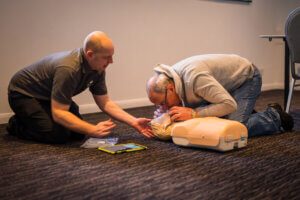
If someone is practising CPR and struggling with their compressions, for example, I’ll guide them towards the correct technique so they can practise it properly.
The aim is never to embarrass anyone or catch them out.
It’s to help people develop the knowledge, skills and confidence to respond when somebody needs them.
I’d much rather someone make a mistake in the training room and learn from it than be too frightened to have a go.
Practical Feedback Makes a Difference
When learners practise CPR, I want them to understand what they’re doing well and what they can improve.
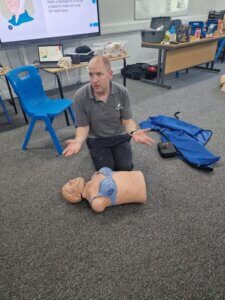
That’s one of the reasons we use QCPR training manikins at White Cross Training.
The feedback technology helps learners see how they’re performing, including aspects of their chest compressions.
Rather than relying entirely on my feedback, learners can see information about their technique and use it to improve through practice.
It’s another example of how a small detail in the training experience can help people build confidence.

The Little Things Add Up
None of these things is particularly complicated.
Arranging the tables, chatting to learners, encouraging questions, adapting examples, involving the group and helping people learn from their mistakes.
They’re all small parts of a training day.
But I believe that when you put them together, they can make a real difference.
At White Cross Training, we’re not just interested in getting people through a course and handing them a certificate.
We want people to leave feeling more confident about what they might need to do in a real emergency.
Because one day, the things they’ve learnt might make a difference to someone else’s life.
And that’s why the little things matter.
Interested in joining us? Explore our Emergency First Aid at Work Level 3 course and discover our practical approach to first aid training.