
Is the Responder Training Market Beginning to Evolve?
The Debate around FREC vs IREC responder qualifications is starting to gain attention across the training sector. For many years, Qualsafe Level 3 Award in First Response Emergency Care (FREC 3) has been one of the most widely recognised responder qualifications in the UK. Training providers have built delivery models around it, employers recognise it by name, and trainers are familiar with its structure.
But the responder training landscape is evolving.
The Level 3 Immediate Response Emergency Care (IREC 3) qualification from FutureQuals is now entering the sector. While newer, it sits at the same clinical level within the PHEM framework and is designed for similar responder roles. Its arrival has naturally sparked conversation across the industry.
The real question isn’t whether one qualification is better.
The real question is whether the sector is ready for change.
FREC vs IREC: Why Change in Qualifications Can Be Positive
In emergency care training, change reflects progress.
Clinical guidance evolves. Equipment improves. Research develops. National frameworks are updated. When qualifications adapt alongside these changes, it shows the sector is moving forward rather than standing still.
New qualifications entering the market can strengthen the industry by:
• encouraging awarding bodies to maintain high standards
• supporting innovation in delivery and assessment
• giving providers more choice
• allowing qualifications to better match real-world responder roles
This is especially relevant as expectations around public safety and emergency preparedness continue to increase, particularly with developments such as Martyn’s Law, which emphasises preparedness, awareness, and effective incident response across organisations.
Healthy sectors evolve. Stagnant ones don’t.
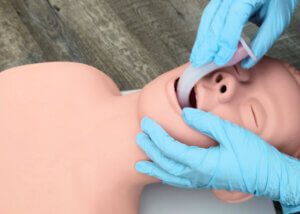
Demonstration of correct oropharyngeal airway insertion technique on a training manikin.
Qualification Evolution and Framework Alignment
Some providers may also have noticed that the FutureQuals First Responder on Scene (FROS) pathway has transitioned toward the IREC Level 3 qualification. The IREC sits at Category D of the PHEM skills framework, the same responder level associated with FREC 3.
While awarding organisations don’t always publicly state the reasoning behind qualification updates, alignment with recognised national clinical frameworks is often a key factor when qualifications evolve. Developments like this show how closely responder training tracks national standards.
Recognition Within Industry Guidance
When comparing responder qualifications such as FREC vs IREC, it’s also important to consider how training aligns with recognised event industry guidance. Documents such as the Purple Guide to Health, Safety and Welfare at Music and Other Events and the Event Safety Guide (Green Guide) emphasise the importance of appropriately trained personnel who can respond effectively to medical incidents. Qualifications that meet recognised responder levels help organisations demonstrate that their staff are trained to nationally understood standards, which is increasingly important for compliance, planning, and public safety assurance.
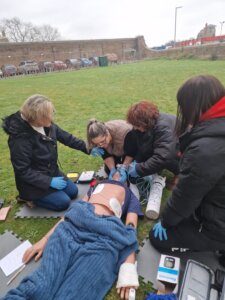
FREC and IREC level responders practising coordinated CPR, AED pad placement and airway management during scenario training.
FREC vs IREC Assessment style differences: Exams vs practical evidence
One of the biggest real-world differences between FREC vs IREC isn’t clinical level, it’s how learners are assessed.
FREC assessment style
- multiple written exam papers
- anatomy exam
- structured testing environment
- defined pass marks per paper
This tends to suit learners who perform well in formal exam settings and prefer clear testing benchmarks.
IREC assessment style
- fewer written exams
- practical assessment emphasis
- competency evidence log
- ongoing observation
This often suits learners who demonstrate skills best through practical scenarios rather than written testing.
Neither approach is better. They simply suit different learners.
Different Qualifications Suit Different Learning Styles
Some learners thrive in structured exam environments. Others demonstrate competence more effectively through scenario-based assessment and practical evaluation.
Having more than one recognised qualification available allows training providers to match delivery to learner needs rather than forcing everyone into one assessment model.
That flexibility benefits learners, instructors, and employers alike.
FREC vs IREC Will the Responder Training Market Diversify?
That’s the question many training providers are beginning to ask.
Will organisations continue delivering the qualification they’ve always delivered because it’s familiar?
Or will more centres begin offering multiple pathways to give learners greater choice?
Market shifts rarely happen overnight. They happen gradually, one provider at a time, until what once felt new simply becomes another accepted option.

Checking pupil response to light, a key neurological assessment skill taught in first aid and responder training.
Why Change in Training Markets Is Often Slow
In regulated training environments, familiarity carries weight. Once a qualification becomes widely adopted, it develops credibility through recognition. Centres build systems around it. Employers request it. Learners search for it.
Switching awarding organisations isn’t a small step. It can involve:
- administrative updates
- quality assurance alignment
- trainer standardisation
- employer reassurance
- internal process changes
That’s why even when alternatives exist, adoption tends to happen gradually.
An Industry Conversation, Not a Competition
The FREC vs IREC isn’t about one qualification replacing another. Both FREC 3 and IREC 3 aim to equip responders with the skills needed to manage prehospital emergencies safely and effectively.
The real discussion is about how the training sector evolves when new options become available.
Strong industries don’t stand still. They adapt, refine, and improve.
And often, progress begins with a simple question:
Are we open to change, or do we prefer what we already know?
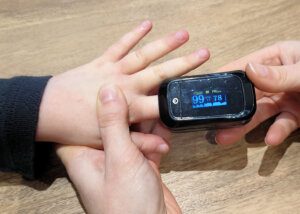
Oxygen saturation monitoring forms part of a structured patient assessment in responder training.